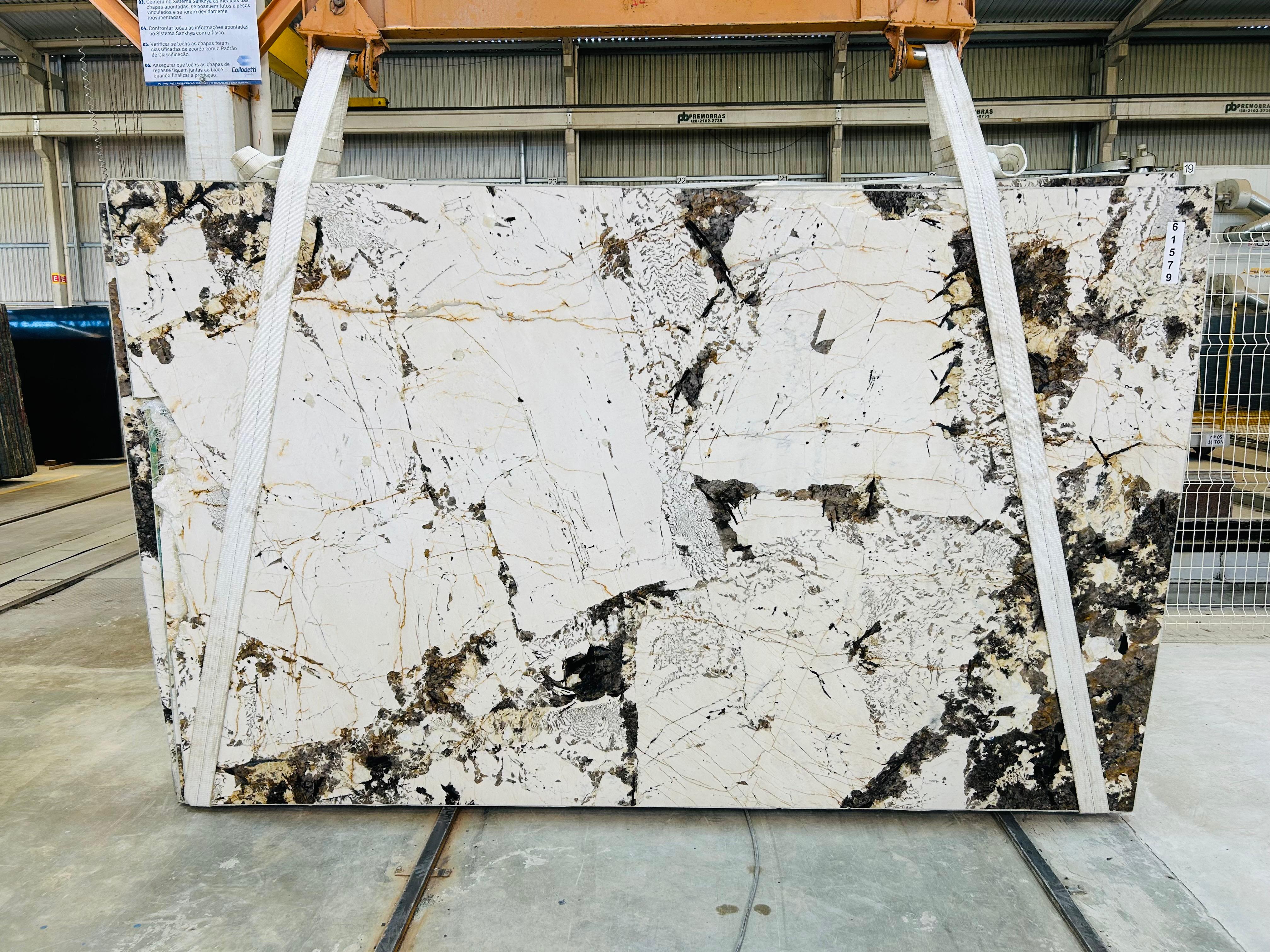
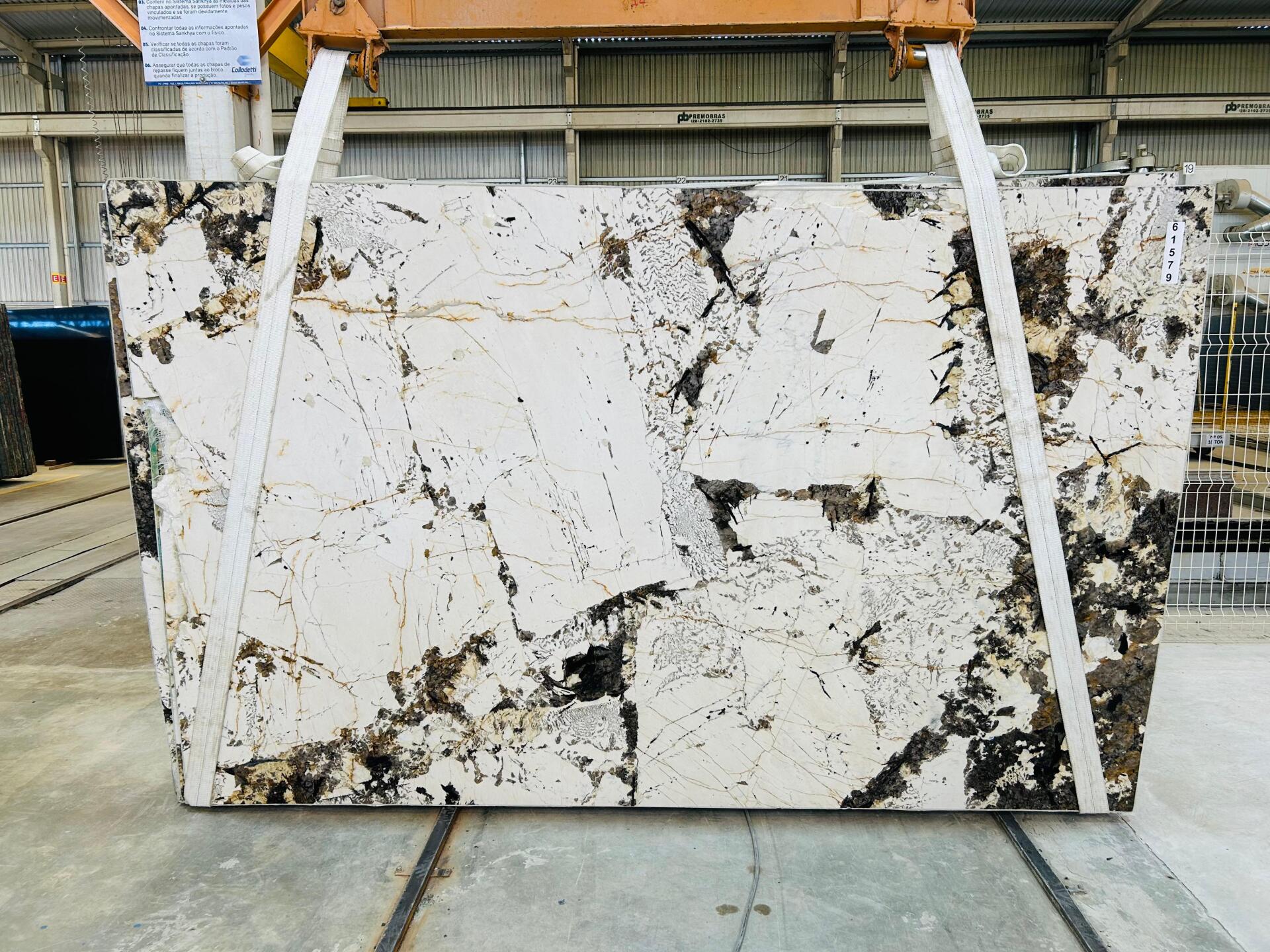
Alpinus is an exotic granite quarried in Brazil, known for its high contrast and bold mineral composition. The stone features a creamy beige and white base interrupted by charcoal crystal clusters, smoky quartz pockets, and thin golden veins. Each slab looks different — swirling patterns give the surface a sense of movement that's hard to replicate.
It's also built to last. Alpinus handles heat well and holds up under heavy daily use, which makes it a strong fit for kitchen countertops and flooring. Some slabs contain translucent quartz sections that can be backlit. When illuminated, the surface glows and exposes layered mineral textures buried inside the stone.
New arrival. Alpinus just came into our Los Angeles yard.
Alpinus is a 2 cm beige, grey, and gold granite, offered in a polished finish. Lot 20935 runs from 126″ × 77″ to 130″ × 81″, with 16 slabs available at our Los Angeles yard.
This slab
The recorded size of a slab in this lot is 130″ × 81″, about 73 square feet. Sizes across the lot run from 126″ × 77″ to 130″ × 81″. Thickness is 2 cm. The color on record is beige, grey, and gold. Natural stone still varies inside that description, so the slab itself is the reference for movement and shade.
The polished finish is reflective and lets the color read clearly. Two centimeters is a standard slab thickness for counters, vanities, and wall cladding.
In the yard
Lot 20935 at our Los Angeles yard shows 16 slabs in stock, none on hold, and 16 slabs available. Available means in stock minus slabs on hold.
The slabs can be compared in daylight at our Los Angeles yard before anything is cut.
Where it works
For this kind of stone, the usual applications are kitchen countertops, vanities, and floors. The right use still depends on the finish, the thickness, and how the slab will be cared for after it is installed. Inspiration photos show this stone in a Kitchen.
The material
Granite is an igneous rock quarried around the world. It is built mostly from quartz, feldspar, and mica, and it is one of the harder stones used on counters. It stands up to heat, scratches, and everyday moisture better than most marble. A uniform color stays close from slab to slab, while a veined granite should still be matched inside the lot before it is cut. A honed face looks matte, a polish looks reflective, and a leather or brushed face feels lightly textured. Ask the fabricator whether this finish should be sealed.
About Alpinus
Alpinus is an exotic granite quarried in Brazil, known for its high contrast and bold mineral composition. The stone features a creamy beige and white base interrupted by charcoal crystal clusters, smoky quartz pockets, and thin golden veins. Each slab looks different — swirling patterns give the surface a sense of movement that's hard to replicate.
It's also built to last. Alpinus handles heat well and holds up under heavy daily use, which makes it a strong fit for kitchen countertops and flooring. Some slabs contain translucent quartz sections that can be backlit. When illuminated, the surface glows and exposes layered mineral textures buried inside the stone.