Types of Calacatta Marble Countertops: A Guide
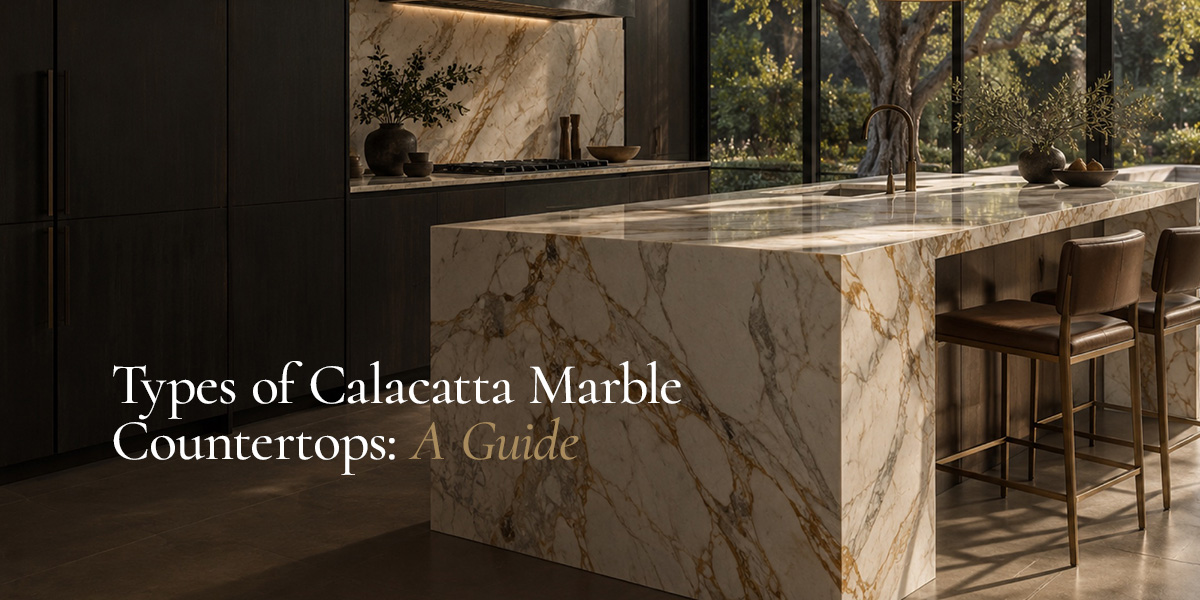
Calacatta marble has long been associated with refined interiors, sculptural veining and the quiet drama of natural stone. Its bright white ground and bold movement make each slab feel architectural, giving designers and homeowners a surface that can anchor an entire room.
The various types of Calacatta, though, make up a sprawling category rather than a single stone, and the market rarely agrees on what to call any given variety within it. One supplier’s Gold is another’s Oro, and a slab labeled Calacatta might be marble or a dolomite with a similar look and its own properties. Specifying or purchasing with confidence starts with sorting out that inconsistency.
What distinguishes each variety comes down to veining character and quarry origin, along with the qualities that separate a good slab from an exceptional one. It’s this knowledge that makes a Calacatta project succeed.
How to Identify the Different Calacatta Marble Varieties
You will first need to understand what Calacatta marble is.
Calacatta is a family name applied to white-ground stones quarried in the Apuan Alps region near Carrara, Italy. Traditionally, the name refers to a metamorphic stone called marble. It is formed when limestone recrystallizes under heat and pressure, with impurities in the original limestone becoming the veining you see in the finished slab.
Other types of Calacatta stone include dolomite varieties and the broader Calacatta-look category that stretches to include quartzite as an alternative.
All true Calacatta varieties share a bright, near-white ground and bold, dramatic veining rooted in Apuan Alps provenance. Calacatta marble colors range from the warm gold and honey of Gold to the cool grays of Vagli. Veining weight, movement and character set each one apart within the Calacatta marble collection. The types of Calacatta marble below cover what buyers should know before specifying the stone.
1. Calacatta Gold
The Calacatta Gold collection pairs a warm white ground with gold and honey veining that moves in broad, sweeping patterns. This is the variety most associated with dramatic, high-contrast luxury interiors:
- Veining character: Bold, directional veining with high contrast against the white base commands attention in luxury kitchens and hospitality interiors.
- How it compares: Apart from Gold Borghini, Gold carries the warmest, boldest veining in the family, more dramatic than Bella and far warmer than the cooler grays of Classico or Vagli.
- Available finishes: Choose a polished or honed finish depending on the desired sheen and performance.
- Bookmatching potential: High. The wide, directional veining creates striking symmetry when mirrored. It’s ideal for waterfall islands and feature walls.
2. Calacatta Gold Borghini
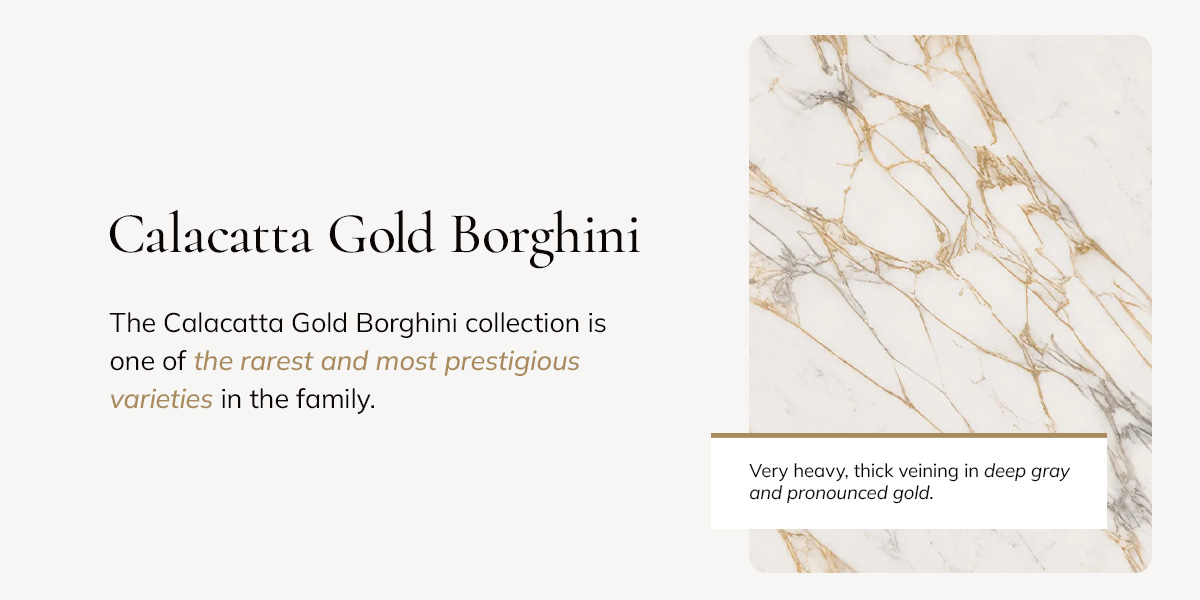
Originating from the Borghini quarry zone of the Apuan Alps, the Calacatta Gold Borghini collection is one of the rarest and most prestigious varieties in the family. Its luminous white ground carries very heavy, thick veining in deep gray and pronounced gold:
- Veining character: The veining runs exceptionally thick and bold, more pronounced than standard Gold and reserved for the most ambitious design commissions.
- How it compares: Gold Borghini pushes further into drama than Gold itself, with heavier, more concentrated veining throughout the slab.
- Available finishes: Choose a polished or honed finish, both suited to showcasing the stone’s exceptional veining.
- Bookmatching potential: High. The thick, dramatic veining creates a powerful mirrored effect, ideal for a room’s singular focal point.
3. Calacatta Bella
The Calacatta Bella collection strikes a balance between presence and restraint. Its ground runs luminous white to warm ivory, veined in elegant gray and taupe with occasional warmer tones:
- Veining character: Movement reads as beautiful rather than theatrical, with a natural flow across the slab.
- How it compares: Bella sits between Gold’s drama and Classico’s precision. It is more refined than Gold and more distinctive than Classico.
- Available finishes: Choose a polished or honed finish. Both are suited to traditional and modern interiors alike.
- Bookmatching potential: High. The natural, flowing movement mirrors beautifully across large islands and feature walls.
4. Calacatta Classico
The Calacatta Classico collection is the purist’s choice. Its crisp white background carries graceful gray veining, ranging from broad and soft to more concentrated and higher contrast:
- Veining character: The gray veining is controlled and precise, never competing with the surrounding design.
- How it compares: Neither as warm as Gold nor as quiet as Vagli, Classico sits at the precise center of the family.
- Available finishes: Polished and honed finishes work well in spaces where the stone complements rather than dominates the design.
- Bookmatching potential: Moderate to high. The graceful veining bookmatches cleanly, though with less drama than Gold or Bella.
5. Calacatta Monet
The Calacatta Monet collection is the family’s most artistic member. Flowing, painterly gray and warm-toned veining moves across a brilliant white ground, organic and never the same twice:
- Veining character: Impressionist in nature, the slab reads as a composition rather than a surface.
- How it compares: More painterly and organic than the directional veining of Gold or Classico, Monet reads as a genuinely one-of-a-kind composition.
- Available finishes: A polished finish lets the painterly veining read at full intensity, while honed suits spaces calling for a slightly less dramatic surface.
- Bookmatching potential: High. The organic pattern creates a distinctive mirrored composition with every bookmatched pair.
6. Calacatta Vagli
The Calacatta Vagli collection takes its name from Vagli Sotto, a mountain village in the Garfagnana area of the Apuan Alps. This geographic specificity signals a distinct variety, not a generic trade name:
- Veining character: The veining is fine to medium and flows in true cool gray tones throughout.
- How it compares: Vagli sits at the quieter, more restrained end of the family, cooler and calmer than Classico, with none of Gold’s warmth.
- Available finishes: Both polished and honed finishes pair well with restrained, contemporary design.
- Bookmatching potential: Moderate. The fine, quiet veining creates a subtler bookmatched effect suited to restrained, minimalist spaces.
7. Calacatta Viola
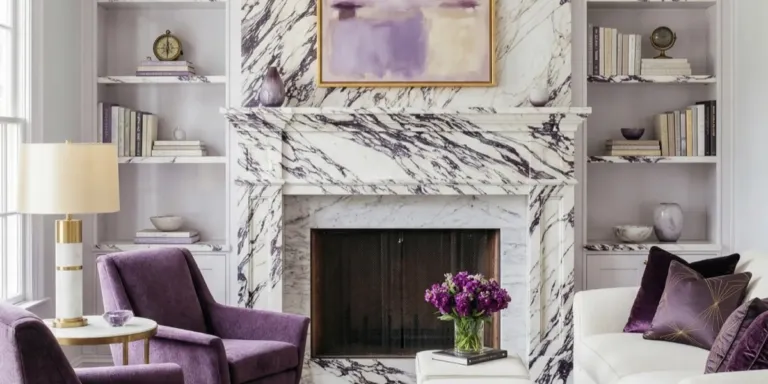
The Calacatta Viola collection is the family’s most variegated member. Its white-to-cream ground carries dramatic, swirling veining in black, gold, green, brown and purple. The distinctive purple streaks give the variety its name.
- Veining character: The multicolor veining swirls in bold, high-contrast patterns unlike any other Calacatta variety.
- How it compares: Viola slabs are colorful, unconventional and far removed from the classic white-and-gray palette of Classico or Vagli.
- Available finishes: Choose a polished, honed or leather finish, with leather adding texture that softens the contrast of the veining.
- Bookmatching potential: High. The dramatic, multicolor swirls create a distinctive mirrored effect.
8. Calacatta Caldia
The Calacatta Caldia collection strikes a refined balance between the restraint of Bianco Carrara and the drama of Gold. Its bright white field carries medium-weight veining in gray and warm, moderate gold tones.
- Veining character: The veining flows in a balanced pattern, warmer than Classico but noticeably more restrained than Gold.
- How it compares: Caldia sits between the quiet precision of Classico and the bold warmth of Gold. It is a versatile middle ground within the family.
- Available finishes: Polished and honed finishes suit the stone’s balanced character.
- Bookmatching potential: Moderate to high. The flowing, medium-weight veining mirrors cleanly across large surfaces without overwhelming a space.
Calacatta Countertop Qualities
Choosing a variety is only the starting point. Finish selection, veining quality, slab grading and bookmatching potential are what elevate a good specification into an exceptional one.
Polished vs. Honed
Both finishes are worth serious consideration — the choice is as much about how you live with the stone as how it looks.
Polished marble brings out the full brilliance of the white ground and makes the veining feel more intense and dramatic. It’s the classic choice, and it’s at its best in spaces that don’t take a daily beating — bathroom vanities, fireplace surrounds, feature walls. Honed marble has a matte, almost velvety surface that’s grown increasingly popular for kitchen countertops because it’s far more forgiving when life happens.
Here’s what’s worth knowing before you decide. Marble is calcite-based, which means acidic substances — a squeeze of lemon, a splash of wine, the wrong cleaning product — can dull the surface on contact. This is called etching, and it’s different from staining. Sealing protects against stains by slowing how quickly liquid absorbs into the stone. It doesn’t stop etching.
A honed finish can make minor etching less noticeable because there’s no gloss to contrast against. On a polished surface, an etch mark tends to stand out more. On a honed one, it may blend more quietly into the matte finish.
Because honed marble is slightly more porous, it benefits from sealing at installation and resealing once or twice a year, depending on how much the surface is used. Implementing a daily care routine can keep a marble slab looking as good as the day it was installed.
Slab Grading and Bookmatching
Not all Calacatta slabs are equal, and the difference is visible once you know what to look for. The best slabs have a clean white ground, veining that is bold and well-defined, and consistent color and movement across the full surface. Fewer fissures, stronger contrast and a more distinctive pattern are the qualities that set one slab apart from another.
Bookmatching is worth understanding before you commit to a large surface. The technique takes two sequential slabs from the same quarry block and mirrors them to create a symmetrical, open-book pattern. On a large kitchen island or a floor-to-ceiling feature wall, the effect is genuinely striking — and Calacatta’s bold veining is one of the best stones for it. Take a look at completed installations to get a sense of what it looks like in a finished space.
One thing to plan for early is seam placement. On a lower-contrast stone, a misaligned seam is easy to overlook. On Calacatta, with its bold directional veining, you’ll immediately notice a poorly placed seam. Getting this right means involving your fabricator in the seam plan before a single cut is made.
For larger projects, it’s worth reserving your lot in advance. Vein intensity and color shift between quarry blocks, and two slabs from different lots can look like different stones side by side. The ideal way to evaluate grading and bookmatching potential is to see the stone in person. Photographs can flatten depth and miss how light moves across the surface, making a showroom visit particularly valuable.
Rarity and Slab Value
Rarity is a central reason why Calacatta marble is so expensive compared to common white marble. The most desirable slabs are harder to source. Buyers often look for a bright white ground, bold veining, balanced movement and enough matching material to complete a project. Slabs with that combination are less common, especially when a design calls for bookmatching or multiple pieces from the same lot.
The final cost also depends on the specific variety, slab quality, finish, fabrication needs and installation complexity. A dramatic Calacatta Gold island, for example, may require more careful layout and seam planning than a smaller vanity top. Evaluating the stone in person helps you understand its value before making a selection.
Which Type of Calacatta Marble Is Best for Your Application?
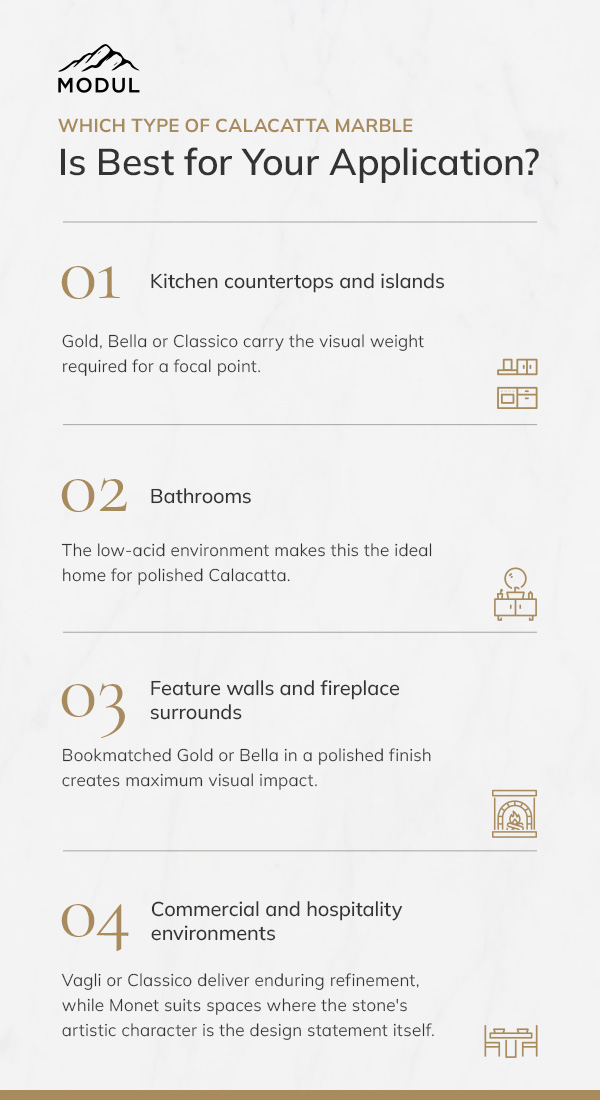
Every application calls for its own balance of drama and restraint, with the Calacatta marble types that suit each space depending on where the slab will live:
- Kitchen countertops and islands: Gold, Bella or Classico carry the visual weight required for a focal point, and a honed finish suits active kitchens well.
- Bathrooms: The low-acid environment makes this the ideal home for polished Calacatta. All varieties perform well here, with Monet or Vagli offering spa-like restraint and Gold or Bella delivering drama.
- Feature walls and fireplace surrounds: Bookmatched Gold or Bella in a polished finish creates maximum visual impact across a large, uninterrupted surface.
- Commercial and hospitality environments: Vagli or Classico deliver enduring refinement, while Monet suits spaces where the stone’s artistic character is the design statement itself.
Selecting the Finishing Touches for Calacatta Countertops
Edge selection is an aesthetic and a structural decision, and on Calacatta, where veining is bold and directional, the right edge profile honors the stone’s natural movement.
Choose based on your aesthetic vision and the practical application:
- Eased edges are clean and modern, ideal for minimalist kitchens.
- Beveled edges bring a contemporary angle to a slimmer profile.
- Bullnose edges soften a room with a traditional, rounded look.
- Ogee edges introduce an S-curve that functions as the Calacatta equivalent of ornate architectural detailing.
- Mitered and waterfall edges deliver an ultra-modern look, achieved with either a thicker slab or laminated edge construction.
The way each profile changes a room becomes clearer once you see how the choice of edge interacts with the stone itself. Close coordination with your fabricator before cutting helps carry bookmatched veining through cleanly from face to edge.
Caring for Calacatta Countertops
Selecting the right Calacatta variety is one decision. Knowing how to care for it is what helps slabs perform beautifully through time.
Maintenance and Long-Term Care
Caring for Calacatta is straightforward once you understand a few core principles, starting with sealing the slab with a penetrating or impregnating sealer after installation. This bonds to the stone for longer-lasting protection than a topical sealer applied to the surface.
Reseal polished Calacatta once or twice a year, with honed finishes on a similar or slightly more frequent schedule, given their added porosity. A simple water bead test tells you when it is time. Pour a small puddle of water, wait fifteen minutes and check whether the stone has darkened beneath it. This is a sign that it is absorbing moisture and ready for a fresh coat of sealer.
pH-neutral stone cleaners keep the surface in top condition, and soft cloths work better than abrasive pads for everyday cleaning.
Sealing helps protect against staining, while etching from acidic liquids like citrus, wine and vinegar may require professional refinishing or a stone-safe polishing product, depending on the severity.
How Long Does Calacatta Last?
With proper sealing, cleaning and routine care, Calacatta marble countertops can last for decades. In many homes, the stone can perform beautifully for the life of the space, especially when homeowners understand how marble responds to daily use.
What changes over time is the surface finish. Because Calacatta is a natural marble, acidic liquids like citrus, wine and vinegar can leave etch marks, and high-use areas may develop a soft patina. This surface evolution is normal for marble. Some homeowners appreciate the lived-in character, while others choose professional refinishing when they want to restore a smoother, more uniform surface.
Finish selection also affects how the stone ages. Polished Calacatta shows etching more visibly because the dull spots contrast with the reflective surface. Honed Calacatta tends to age more quietly in active kitchens because the matte finish makes everyday wear less noticeable.
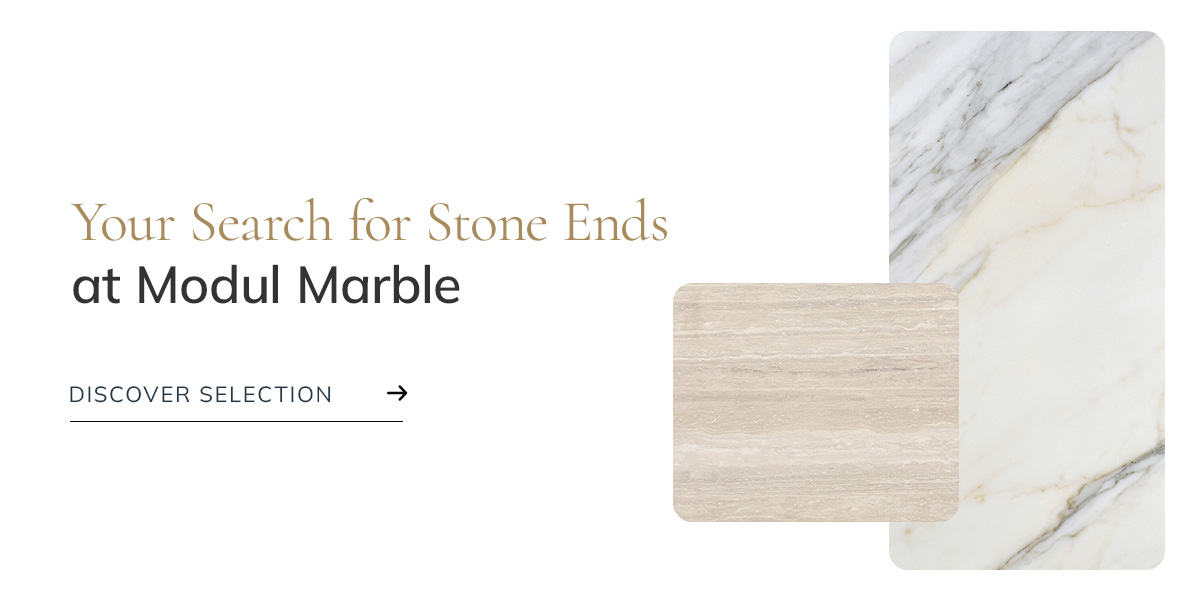
Your Search for Stone Ends at Modul Marble
For over 30 years, we’ve built our reputation on sourcing the world’s finest natural stone, and our Calacatta collection reflects that standard. Every slab arrives from a select partner around the globe. Its path to your project is a story worth knowing before it becomes part of your home. Visit our Sun Valley, California, showroom to explore our live inventory in person.
Our natural stone experts bring industry-leading knowledge to every conversation, working as your partner to match the right variety, finish and slab to your vision. Discover our current slab selection and contact Modul Marble today.