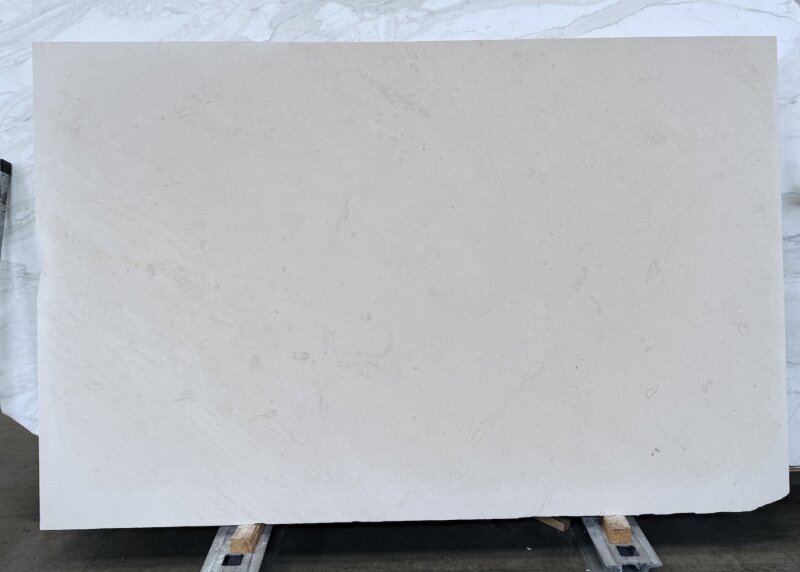
On hand at our Los Angeles yard: 3 slabs of Bateig Crema, a 2 cm beige limestone from Spain in a honed finish. Lot LS11100 measures about 112″ × 57″.
This slab
The recorded size of a slab in this lot is 112″ × 57″, about 44 square feet. Thickness is 2 cm. The color on record is beige. Natural stone still varies inside that description, so the slab itself is the reference for movement and shade. This material is recorded as quarried in Spain.
The honed finish is smooth and matte, without a high gloss. Two centimeters is a standard slab thickness for counters, vanities, and wall cladding.
In the yard
Lot LS11100 at our Los Angeles yard shows 3 slabs in stock, none on hold, and 3 slabs available. Available means in stock minus slabs on hold.
The slabs can be compared in daylight at our Los Angeles yard before anything is cut.
Where it works
For this kind of stone, the usual applications are floors, wall cladding, and vanities. The right use still depends on the finish, the thickness, and how the slab will be cared for after it is installed.
The material
Limestone is a sedimentary stone, usually calmer in pattern than marble, with a soft mineral color. It is more porous than granite and is a frequent choice for floors, cladding, and vanities. Honed and brushed finishes suit its matte character. Acidic products can etch it, and a sealer is often part of the care plan. Slabs from the same lot are the right set to compare for shade before they are cut.
About Bateig Crema
Bateig Crema, also known as Bateig Beige or Piedra Novelda, is a prestigious biocalcarenite limestone quarried in the Alicante province of Spain. Renowned for its remarkable homogeneity and fine-grained texture, this stone features a warm, sandy beige palette accented by subtle fossil traces. Its versatile nature and structural integrity make it a staple for both Mediterranean and contemporary architecture, ranging from intricate heritage restorations to minimalist high-traffic flooring. Interestingly, while geologically a limestone, its compact composition and uniform appearance have led many to commercially classify it as a sandstone throughout its 140-year extraction history.