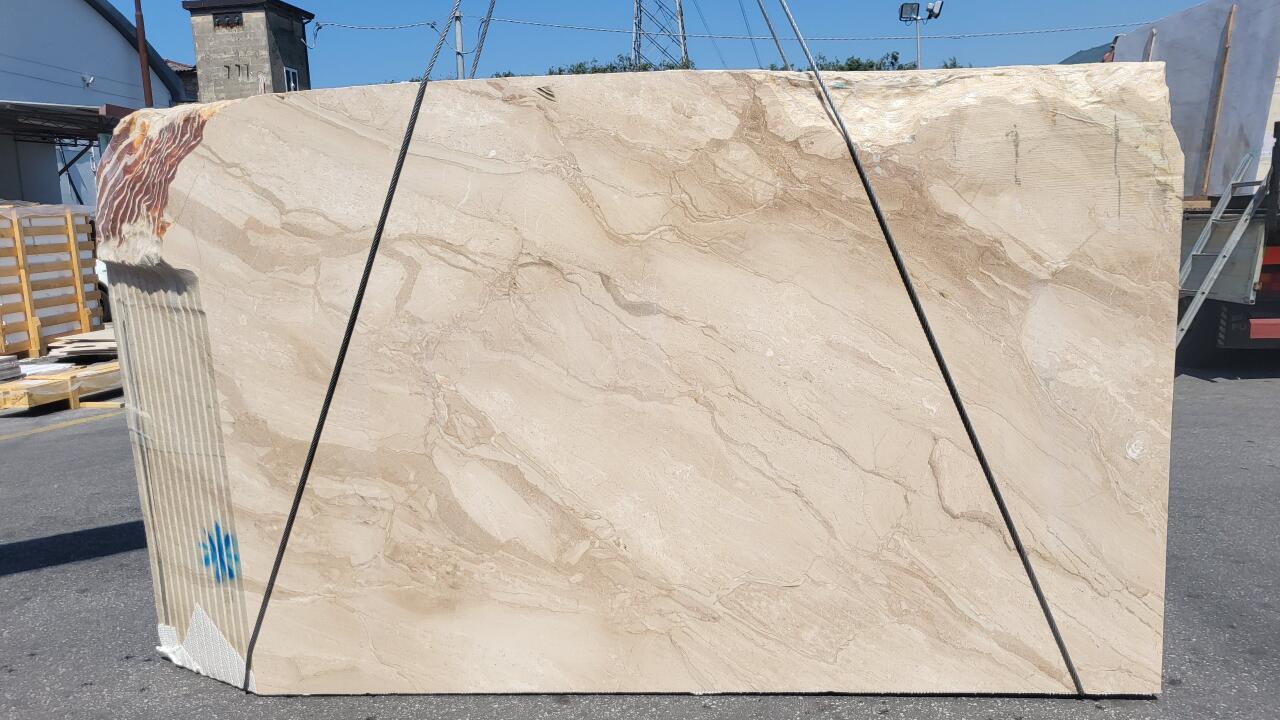
This marble is Paonazzo Corchia, in gold, with a polished finish, cut at 2 cm, and quarried in Italy. Lot 21214A measures about 115″ × 56″ at our Los Angeles slab gallery.
This slab
The recorded size of a slab in this lot is 115″ × 56″, about 45 square feet. Thickness is 2 cm. The color on record is gold. Natural stone still varies inside that description, so the slab itself is the reference for movement and shade. This material is recorded as quarried in Italy.
The polished finish is reflective and lets the color read clearly. Two centimeters is a standard slab thickness for counters, vanities, and wall cladding.
In the slab gallery
The slabs can be seen in person at our Los Angeles slab gallery before anything is cut.
Where it works
For this kind of stone, the usual applications are bathrooms, vanities, fireplace surrounds, and feature walls. The right use still depends on the finish, the thickness, and how the slab will be cared for after it is installed. Inspiration photos show this stone in a Modern Bathroom.
The material
Marble is a metamorphic stone, recrystallized from limestone, and it is valued for veining and a luminous surface. It is softer and more sensitive to acids than granite or quartzite, so wine, citrus, and strong cleaners can etch a polish. That is why it is a classic for bathrooms, vanities, fireplaces, and walls, and for kitchens when the owner wants the look and will live with a natural patina. A honed face shows etching less than a high polish. Vein direction should be planned on the actual slabs before fabrication.
About Paonazzo Corchia
Paonazzo Corchia is a prestigious Italian marble extracted from the renowned quarries of the Carrara region in Tuscany. This rare stone is celebrated for its ivory-white or deep-white background, dramatically interrupted by a bold, brecciated structure of veins that range from golden and honey tones to deep violet and charcoal. Its name, "Paonazzo," is derived from the Italian word for peacock, a nod to the vibrant, multi-colored halos that often surround its dark veining. Historically significant, this marble has been a favored material since antiquity, used in the columns of the Hadrian Mausoleum and across various architectural eras from Art Nouveau to Art Deco. Its striking, painterly appearance makes it a premier choice for high-end interior applications, including statement countertops, elegant flooring, and luxurious wall cladding.