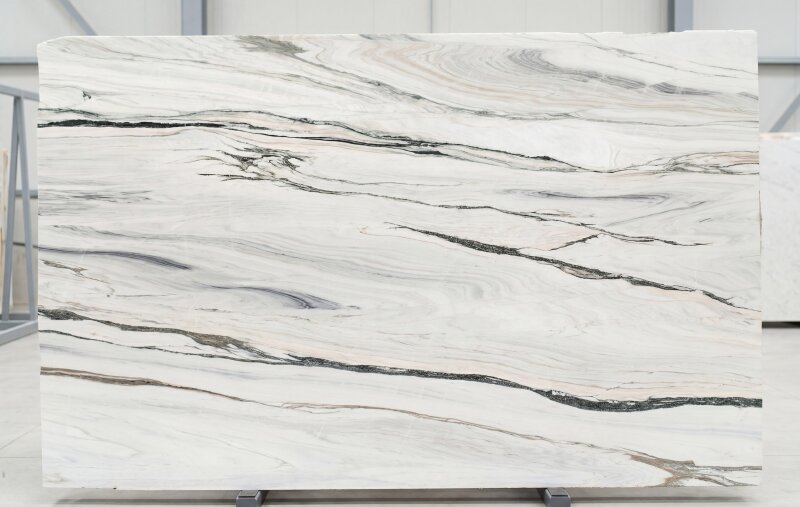
This marble is Pigon White, with a polished finish, cut at 2 cm, and quarried in Greece. Lot 63948 measures about 104″ × 63″ at our Los Angeles slab gallery.
This slab
The recorded size of a slab in this lot is 104″ × 63″, about 46 square feet. Thickness is 2 cm. The color on record is white. Natural stone still varies inside that description, so the slab itself is the reference for movement and shade. This material is recorded as quarried in Greece.
The polished finish is reflective and lets the color read clearly. Two centimeters is a standard slab thickness for counters, vanities, and wall cladding.
In the slab gallery
The slabs can be seen in person at our Los Angeles slab gallery before anything is cut.
Where it works
For this kind of stone, the usual applications are bathrooms, vanities, fireplace surrounds, and feature walls. The right use still depends on the finish, the thickness, and how the slab will be cared for after it is installed. Inspiration photos show this stone in a Modern Bathroom.
The material
Marble is a metamorphic stone, recrystallized from limestone, and it is valued for veining and a luminous surface. It is softer and more sensitive to acids than granite or quartzite, so wine, citrus, and strong cleaners can etch a polish. That is why it is a classic for bathrooms, vanities, fireplaces, and walls, and for kitchens when the owner wants the look and will live with a natural patina. A honed face shows etching less than a high polish. Vein direction should be planned on the actual slabs before fabrication.
About Pigon White
Pigon White, also known as Pirgon or White of Pighes, is a premier dolomitic marble quarried in the Drama region of Northern Greece. Celebrated for its luminous white background and soft, smoky grey or beige linear veining, it offers a serene alternative to bolder Italian varieties. Geologically, its high dolomite content (often over 90%) grants it superior density and lower water absorption compared to standard calcitic marbles, making it exceptionally durable for countertops and high-traffic flooring. Interestingly, the quarry region is often called the Carrara of Greece, and the stone’s appearance is so brilliant it has been compared to a vast expanse of sunlit snow.