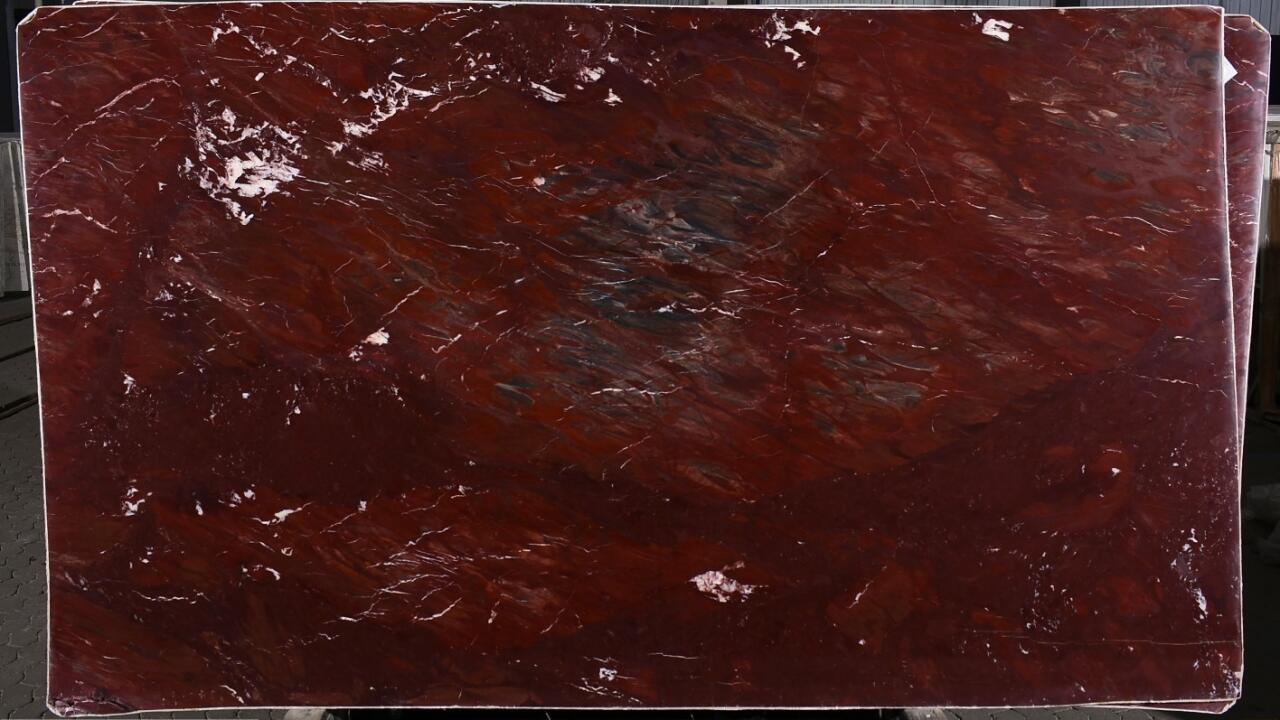
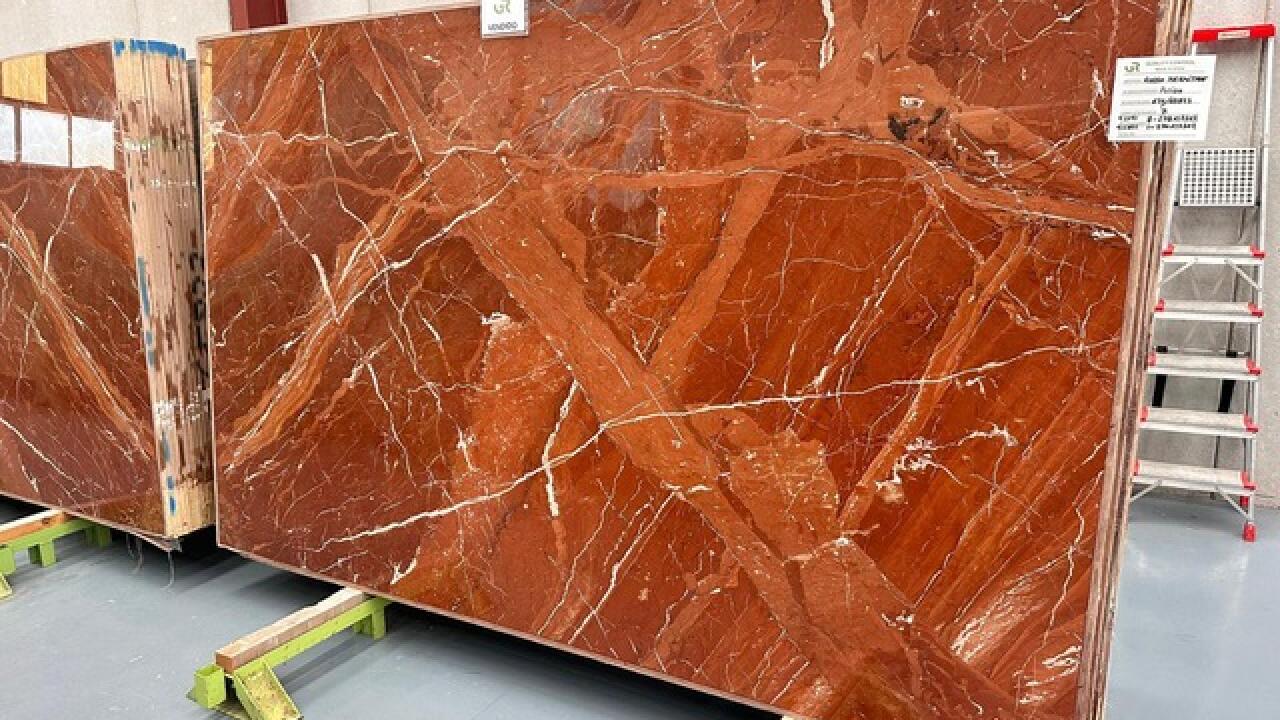
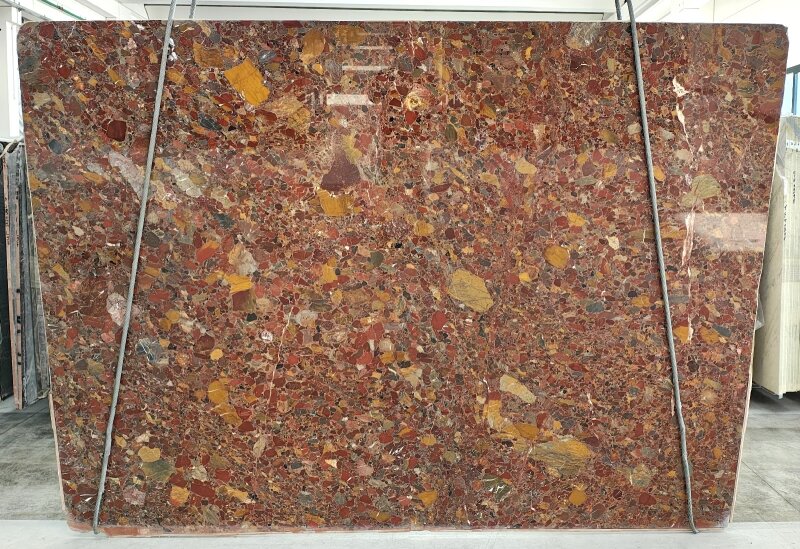
On hand at our Los Angeles yard: 4 available slabs of Rosso Levanto, a 2 cm red with white, black, and brown marble in a polished finish. Lot SM1456 measures about 125″ × 76″, with 6 slabs on hold.
This slab
The recorded size of a slab in this lot is 125″ × 76″, about 66 square feet. Thickness is 2 cm. The color on record is red with white, black, and brown. Natural stone still varies inside that description, so the slab itself is the reference for movement and shade.
The polished finish is reflective and lets the color read clearly. Two centimeters is a standard slab thickness for counters, vanities, and wall cladding.
In the yard
Lot SM1456 at our Los Angeles yard shows 10 slabs in stock, 6 slabs on hold, and 4 slabs available. Available means in stock minus slabs on hold.
The slabs can be compared in daylight at our Los Angeles yard before anything is cut.
Where it works
For this kind of stone, the usual applications are bathrooms, vanities, fireplace surrounds, and feature walls. The right use still depends on the finish, the thickness, and how the slab will be cared for after it is installed.
The material
Marble is a metamorphic stone, recrystallized from limestone, and it is valued for veining and a luminous surface. It is softer and more sensitive to acids than granite or quartzite, so wine, citrus, and strong cleaners can etch a polish. That is why it is a classic for bathrooms, vanities, fireplaces, and walls, and for kitchens when the owner wants the look and will live with a natural patina. A honed face shows etching less than a high polish. Vein direction should be planned on the actual slabs before fabrication.
About Rosso Levanto
Rosso Levanto is a dramatic and sophisticated marble, primarily quarried in the Liguria region of Italy, near the town of Levanto. It is characterized by its deep, wine-red to burgundy background, which is strikingly contrasted by bold, white-to-gray calcite veining. This stone is not a typical calcitic marble but a serpentinite-rich metamorphic rock, giving it exceptional depth and durability.
Celebrated since the Roman Empire, it was historically used for grand columns and imperial palaces. Its intense coloration, derived from iron oxide minerals, makes it a favored choice for luxury interiors, from statement countertops to ornate bathroom claddings. Interestingly, while most synonymous with Italy, similar varieties are also found in Turkey, though the original Italian quarries remain the most prestigious source.