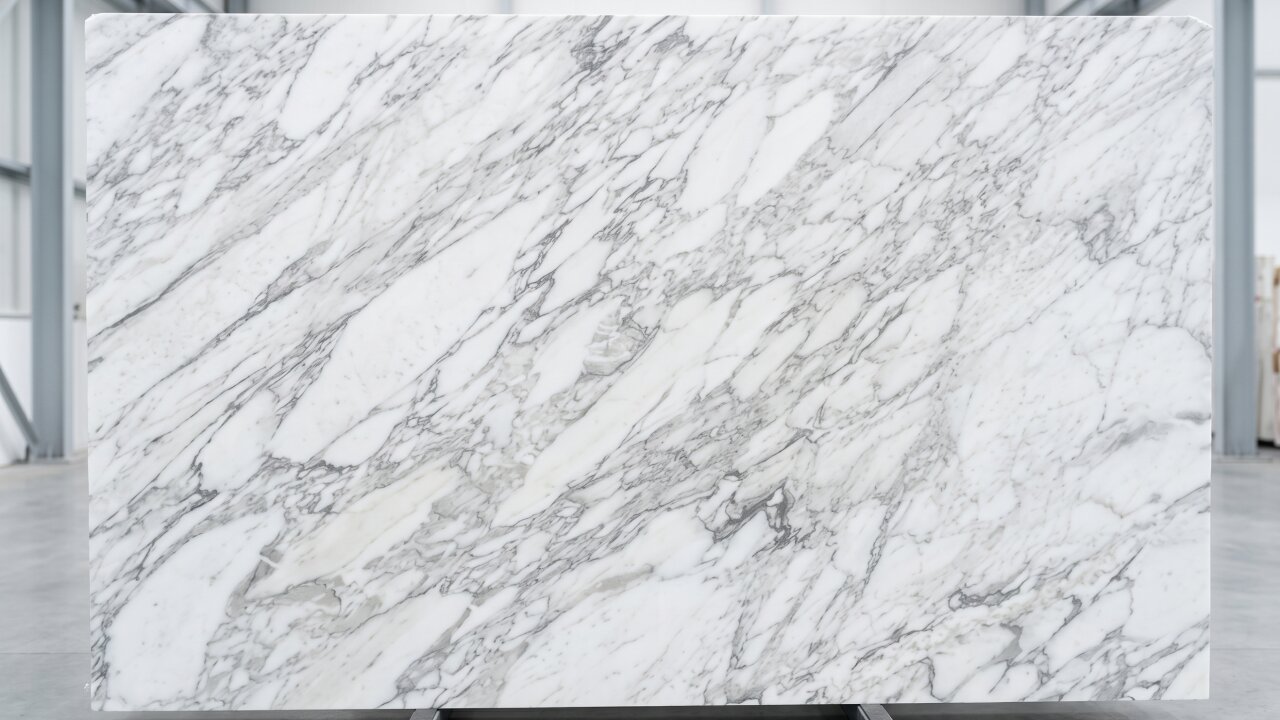
Calacatta Paonazzo, also known as Calacatta Antica — 2 cm white marble, polished, about 113″ × 65″ per slab. Lot 24002, from Italy, has 2 slabs available at our Los Angeles yard.
This slab
The recorded size of a slab in this lot is 113″ × 65″, about 51 square feet. Thickness is 2 cm. The color on record is white. Natural stone still varies inside that description, so the slab itself is the reference for movement and shade. Calacatta Paonazzo is also known as Calacatta Antica. Searching either name should lead to this same material. This material is recorded as quarried in Italy.
The polished finish is reflective and lets the color read clearly. Two centimeters is a standard slab thickness for counters, vanities, and wall cladding.
In the yard
Lot 24002 at our Los Angeles yard shows 2 slabs in stock, none on hold, and 2 slabs available. Available means in stock minus slabs on hold.
The slabs can be compared in daylight at our Los Angeles yard before anything is cut.
Where it works
For this kind of stone, the usual applications are bathrooms, vanities, fireplace surrounds, and feature walls. The right use still depends on the finish, the thickness, and how the slab will be cared for after it is installed. Inspiration photos show this stone in a Stairs and an Accent wall.
The material
Marble is a metamorphic stone, recrystallized from limestone, and it is valued for veining and a luminous surface. It is softer and more sensitive to acids than granite or quartzite, so wine, citrus, and strong cleaners can etch a polish. That is why it is a classic for bathrooms, vanities, fireplaces, and walls, and for kitchens when the owner wants the look and will live with a natural patina. A honed face shows etching less than a high polish. Vein direction should be planned on the actual slabs before fabrication.
About Calacatta Paonazzo
Calacatta Paonazzo, also known as Calacatta Antica, is an elite Italian marble quarried from the legendary Apuan Alps in Tuscany. Distinguished by a pristine, cool white to ivory background, it is celebrated for its bold, dramatic veining that shifts through a spectacular palette of deep grey, honey gold, and rusty amber. Its name, derived from the Italian word for peacock, hints at the vibrant, iridescent quality of its mineral-rich veins. This rare stone offers a sophisticated, "old-world" aesthetic that has graced grand European architecture for centuries. Historically, its striking patterns were so coveted that it was specifically chosen for the Corinthian columns of the Hadrian Mausoleum in Rome. Today, it remains a premier choice for high-end focal points, including book-matched feature walls and luxury countertops.